The Chinese “I Ching” Coins as Seen on “Mad Men”

On the episode of AMC’s Mad Men that aired on 19 May 2013, a flower child named Wendy uses the I Ching to answer Don Draper’s question. “You don’t even need to say it out loud,” she says. “Just think it.”

She then tosses three coins on the coffee table, and from that coin toss, divines the answer to what she thinks Don’s question might be. (“Your question is, Does anyone love me. That’s everybody’s question.”)

Said coins look like this:

Your questions, Dear Reader, when watching the episode, may well have been, “1) What kind of coins are those? And 2) where can I get some?”

The answer to the first question: bronze Chinese cash coins, probably from the Song Dynasty, dating from 960-1279 CE.

The answer to the second question: right here.


Posted in Lore of Money | Tagged , , , , | Leave a comment

India’s Polyglot Banknotes

The primary official language of India is Standard Hindi, while English is the secondary official language. No surprise, then, that these are the two languages represented on the front of this 10 rupee banknote:

But those are hardly the only two tongues spoken on the subcontinent. According to Census of India of 2001, 30 languages are spoken by more than a million native speakers, and a whopping 122 by more than 10,000.

As a tip of the cap to the polyglot population, the reverse of the note has “ten rupees” spelled out in 15 other languages. You can see the script beneath the “10″ on the top left:

The languages represented here are Assamese, Bengali, Gujarati, Kannada, Kashmiri, Konkani, Malayalam, Nepali, Oriya, Punjabi, Sanskrit, Tamil, Telugu, and Urdu.

For wholesale information on these gorgeous banknotes, click here.

Posted in Lore of Money | Tagged , , , , | Leave a comment

This Week in History: George VI Crowned King

On may 12, 1937, George VI was crowned King of the United Kingdom and the Dominions of the British Commonwealth. He assumed the throne when his older brother, Edward VII, abdicated in order to marry a divorced American socialite, Wallis Simpson.

George VI was the last Emperor of India. The United Kingdom has not had a king since his death in 1952, when his daughter, Elizabeth II, became queen. He is probably best known to contemporaries as the subject of the film The King’s Speech, where he is played with aplomb by Colin Firth.

For wholesale information on this “thrupence” coin, click here.


Posted in Lore of Money | Tagged , | Leave a comment

The Wreck of the Admiral Gardner

January 25, 1809. Despite bitter cold and an ominous black sky, the Admiral Gardner, a three-masted brig loaded with some 46 tons of copper coins, embarked on the long journey from London to the East Indies. It didn’t get far. Caught in a gale, the ship sunk into the Goodwin Sands, 80 miles from London.

No trace of the ship was found until 1984, when a passing fisherman snagged his nets on the wreckage. A year later, a team of divers salvaged some—but not nearly all—of the lost treasure, including a sealed barrel containing some 28,000 pieces. This East India Company “10-cash” coin is one of them:

For wholesale information on these coins, click here.

Posted in Shipwreck & Treasure Coins | Tagged , , , , | Leave a comment

St. George’s Day

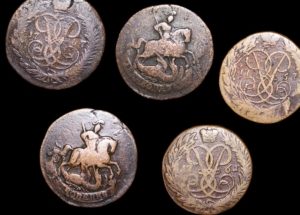
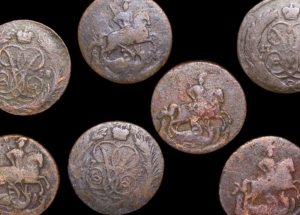
Today is St. George’s Day, the feast day celebrated each year on April 23, the day on which he was thought to die in 303 CE. The image of St. George on his horse, slaying the dragon, is a familiar one to numismatists, as it has appeared on many coins, particularly in Russia.

Russian wire money, in particular, makes use of this classic image. Michael Romanov made use of them on his coins.

Posted in Lore of Money | Leave a comment